The Coaching Craft
Train the Fundamentals: What Coaches Can Steal from Sports
Every other performance profession drills its basics for life. Coaching certifies people and lets them stop practicing. The fundamentals of the craft, and how to actually train them.
· The Coaching Craft · 8 min read
Watch · 32s
Prefer to watch? The whole essay, in 32 seconds.
Same argument, same ending. The written version is right below.
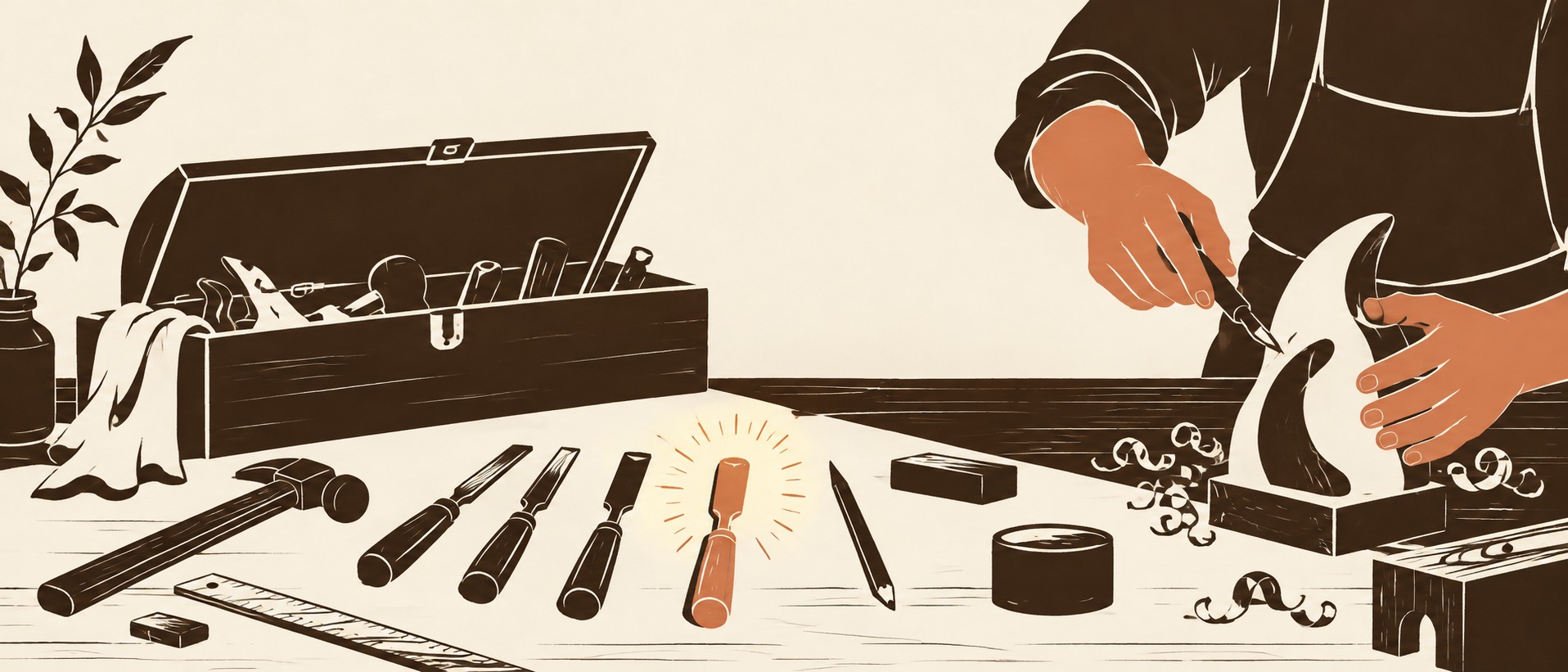
Watch what a professional athlete does the morning after a season ends. Not rest — not yet. They go back to the gym, and they drill the same movements they drilled at nine years old. Footwork. Grip. Follow-through. At the top of every performance profession on earth, this is settled law: the fundamentals get trained forever, by everyone, at every level — especially at the highest level. Novak hits ten thousand more forehands.
Now watch what a certified coach does the week after certification. They… coach. Matches, immediately, forever. No drills. No reps. No film. No off-season. There is no practice in the entire profession — there is only game day. Coaching may be the only performance profession in the world that certifies people and then never asks them to practice again.
That’s the quiet reason so much coaching is mediocre, and it’s fixable, and the fix is borrowed wholesale from sport.
Why the top drills the bottom
First, the sports logic, because it’s better than any coaching argument. At the professional level, everyone has technique. The differences that decide matches are not differences in fancy shots — they’re differences in how reliably the basics hold when the match gets close, the legs get heavy, and the money is on the line. Sets aren’t won by spectacular shots. They’re won by whoever’s forehand degrades slower under pressure. Mastery isn’t knowing advanced material. Mastery is fundamentals that don’t collapse when the stakes rise.
Now translate. What actually happens in a hard session? The client says the sentence that hooks your own material, your certainty wobbles, the silence gets expensive — and in that pressure window, whatever is automated in you is what comes out. Your automated listening or your automated advice. Your automated question or your automated reassurance. Under pressure, you don’t rise to the occasion; you sink to your training. Everyone knows this about athletes. It’s just as true about coaches, and never discussed.
Novelty, meanwhile, is the sugar of every craft. New techniques, new frameworks, a better question from a conference — each feels like progress. It isn’t. It’s escape from boring mastery. The athlete who changed serve motion every month wouldn’t be experimenting; they’d be refusing to train. Coaches do exactly this, and the industry sells it to them, continuously, with certificates.
The fundamentals of this craft
Sports has clarity about its basics. Here’s ours, argued tightly — the shortlist of what degrades under pressure and wins matches when it holds:
Listening. The full skill, not the polite waiting version — the three levels: words, model, person. The most pressure-fragile skill in coaching, because under your own tension, attention contracts to your next move. The tell that it’s collapsed: you’re planning your sentence while they finish theirs.
The repeat-back. Hold the “did I get that right?” loop until the yes. Under pressure, coaches skip it — it feels too slow — and then solve the wrong problem at speed, elegantly.
The gradient. Sizing every next move to the person’s current capacity — the right gradient. Under pressure, gradients steepen involuntarily: you push your good material at whatever altitude the client can’t receive it. Gradient control is a trained reflex, not an insight.
Presence. Your own operating state — entering sessions in performance mode, not survival; noticing your mode mid-session when it slips. Every athlete knows the body decides late matches. Every coach forgets the state decides hard sessions.
The definition. Producing, with the client, the defined result — the one sentence with an arrival test. Vagueness is what a pressured session collapses back into: warm fog.
Five fundamentals. Notice they’re all trainable behaviors — observable, correctable, repeatable. That’s what makes them drillable, which is the entire point.
The training system, stolen properly
Don’t take sports’ slogans — take its system. Four pieces of it, adapted without ceremony:
Reps with correction, not volume. Ten thousand unexamined sessions don’t build skill; they entrench whatever you currently do. The athlete’s rep always carries feedback — a coach’s eye on the stroke. Yours: pick one fundamental, design a small version of it, run it, and get it corrected — by a peer, a supervisor, or the cheapest honest mirror available: a recording of yourself, reviewed like film.
Film review. With permission, record sessions. Once a month, review twenty minutes of one, against one fundamental only: “Count my repeat-backs. Did I get the yes? Where did my listening collapse?” What coaches find in their first recording is what athletes always find in their first film: the self-image and the footage disagree, and the footage is the coach.
Pressure training. Practice doesn’t stay at practice speed — it edges toward game speed, then past it. Your version: take the fundamentals into deliberately harder rooms — the skeptical client, the friend who won’t play along, the colleague who role-plays the defensive case from handling the stuck client. A skill trained only in easy conditions has only easy conditions in it.
An off-season, or at least a training block. Athletes don’t train during matches and only matches — they build seasons with actual practice in them. Coaches need one hour a week that is not client-facing, not administrative: practice time, protected like a session, because it is one — it’s just for the player you forgot to train.
The boring truth, which is the good news
Here’s the closing reframe, and it’s genuinely encouraging: almost nobody in this profession is doing this. The bar for “trained coach” is set by certification reading lists and hours accumulated — not by reps corrected, film reviewed, fundamentals pressure-tested. The entire competitive edge of this essay is available to anyone willing to do something unglamorous that almost no colleague will mock you for doing but almost no colleague does.
Ten forehands a day. One recorded session a month. One deliberate rep per conversation, one training hour per week. That’s the whole program — smaller than anyone expects, because fundamentals were never the impressive part of any profession. They’re just the part that decides, late in the match, when it’s close and everyone else’s game has started to degrade.
This week's practice
Pick one fundamental — listening, repeat-back, gradient, presence, or definition — and design its smallest rep. Run the rep five times this week in real conversations, one line of notes per rep: what held under pressure, what collapsed. Five lines by Sunday.
Then install the film habit: record one real session this month (with permission — consent is part of the skill), review twenty minutes against your chosen fundamental, and write down the one difference between the self-image and the footage. That gap, closed slowly, is the entire profession's real training program.
Foundations & further reading
The ideas here are my synthesis. The research that rhymes with them isn't new — if you want to go deeper than the essay, these are the sources I'd hand you first.
- Anders Ericsson & Robert Pool, Peak (2016) — Deliberate practice: full attention on the weakest link, with feedback, at the edge of ability. The science of why drills beat games for fundamentals.
- Doug Lemov, Practice Perfect (2012) — How great practitioners practice: isolate the skill, shorten the loop, normalize error. Fundamentals training design from the Teach Like a Champion lab.
- Daniel Coyle, The Talent Code (2009) — Deep practice and myelin: why slow, chunked, error-rich repetition builds skill faster than volume. The science coaches keep rediscovering.